About
This site is a little project that lets me make fun of some things and sense of others. I use it to think a little more relationally without resorting to doing actual math.Subscribe
Archives
- May 2012
- April 2012
- March 2012
- February 2012
- January 2012
- December 2011
- November 2011
- October 2011
- September 2011
- August 2011
- July 2011
- June 2011
- May 2011
- April 2011
- March 2011
- February 2011
- January 2011
- December 2010
- November 2010
- October 2010
- September 2010
- August 2010
- July 2010
- June 2010
- May 2010
- April 2010
- March 2010
- February 2010
- January 2010
- December 2009
- November 2009
- October 2009
- September 2009
- August 2009
- July 2009
- June 2009
- May 2009
- April 2009
- March 2009
- February 2009
- January 2009
- December 2008
- November 2008
- October 2008
- September 2008
- August 2008
- July 2008
- June 2008
- May 2008
- April 2008
- March 2008
- February 2008
- January 2008
- December 2007
- November 2007
- October 2007
- September 2007
- August 2007
- July 2007
- June 2007
- May 2007
- April 2007
- March 2007
- February 2007
- January 2007
- December 2006
- November 2006
- October 2006
- September 2006
- August 2006
Categories
- 5×7
- arrogance
- booze
- brands
- communication
- consumption
- creeps
- crime
- easter bunny
- ego
- ethics
- excuses
- expectations
- experience
- faith
- family
- fashion
- finances
- friends
- gum
- halloween
- hipsters
- inequality
- kids
- language
- love
- men
- moderation
- monsters
- music
- optimism
- orthodontics
- pain
- parties
- patience
- perception
- philosophy
- politics
- pop culture
- queens
- santa
- school
- sickness
- snobs
- snuggling
- sports
- standards
- stress
- success
- technology
- television
- tooth fairy
- travel
- Uncategorized
- value
- virginity
- weight
- women
- work
- xenophobia
Zoom out.
This entry was posted in perception. Bookmark the permalink.


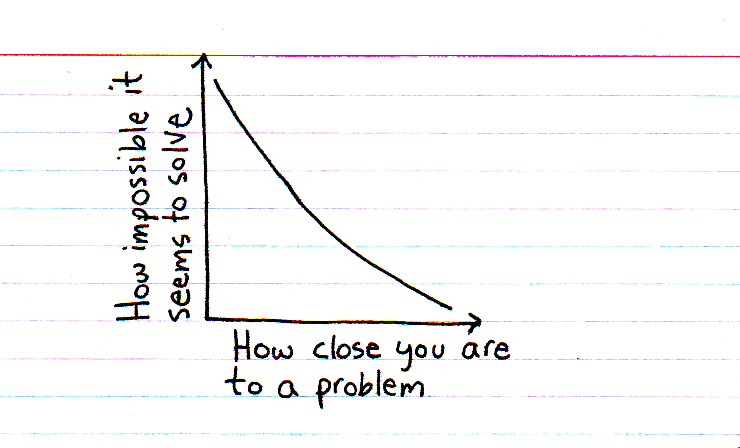
Hmm, judging by the title and, um, interestingness?, did you intend for one of these axes to be flipped? Eg. “distance from problem” on the x axis.
this seems backwards
No, it says the farther away the easier a problem is. Meaning if your not near the problem you don’t need to solve it, or it seems easier. For instance any welder would say “Oh I can fix that BP oil spill with a simple plate of metal on top the broken well” If they are, oh say in Alaska. Hence the title “Zoom Out”.
NO – the drawing is correct. It means that if you are too close to a problem, you “can’t see the forest for the trees.” You must distance yourself from a problem to be unemotional about it and have the best chance to solve it.
But the x-axis is “closeness”. Less closeness to more closeness. So it says the closer you are, the less impossible the problem seems.
I concur, one of the axes should be flipped.
There’s no real good way to draw it.
Saying “How far you are from a problem” loses a lot of the “umph” factor of the comic as is.
But, when we measure “closeness”, the concept is so literally physical that a “high” degree of “closeness” shows up in our mind’s eye as being a small distance [since "closeness" is a "small distance", literally].
A “small distance” ["high closeness"] on a graph would be “not far” from the origin, intuitively.
So, however you draw or label it, there’s a conflict between the literal meaning / connotation and the mathematical directionality. If you were to reverse the x-axis, it would feel weird for the exact opposite reason.
* If you are too close to (i.e not far from) the problem, it seems quite impossible, because you are stuck in the problem and it blinds you to other possibilities.
* If you are you too far (i.e. not close) from the problem, you don’t understand how complex and interrelated the context and multiple factors are, and thus it seems not impossible at all.
* A middle point: if you are close enough, you can seem how complicated it is, but not understand the factors in a deep enough way as to see how to untangle or balance them. Thus, it seems impossible, but not quite as impossible as if you are way too close.
* Another middle point, one closer than the first middle point: If you are close enough you can see and understand the problem and its context, but understand it deeply enough — without being blinded by your inhabiting the problem — to see a solution. Thus, it seems less impossible than if you were just a bit closer or just a bit less close. A local minimum of seeming impossibility. But not as non-impossible as one who is truly far away.
So, the curse should start very high, drop down quickly, rise up quickly again, and then slowly drop out to infinity (perhaps with little squiggles along the way)
It should be flipped because if you are farther away from a problem (i.e. less close, near the origin on the x-axis), you feel it is simpler to solve, which should be close to the origin on y as well. Hence, you could either flip an axis or draw the graph with a positive slope :)
Perhaps this is more of a physical relationship. When you are very far from a problem (low closeness) it seems difficult to solve said problem (high impossibility).
For example, physically being in Chicago makes it seem impossible to solve a problem in Africa.
But when you get more close, it seems like you are able to solve the problem
This is also why my boss thinks I should be able to solve complex problems instantly. Everything looks easy if you don’t know the details.
At first I thought it should be flipped.
If you interpret the X axis as a sliding scale from left to right with left being “too close” to a problem and the far right as being “not close” then it will show “Can’t see the forest from the trees” or more specifically what Zabulon said.
The X axis is distance.
Distance can be described as, “How close you are.”
It’s kind of like dancing–the more you think about it, the sillier you look.
If you’re having trouble understanding this, back away from the monitor a bit and you’ll understand.
Wow. So many responses regarding the ‘incorrectness’ of the graph. It makes perfect sense to me!
(I love Starhowl’s response, by the way!)
Seems pretty clear to me. From a software development perspective, at least. Breaking up initial problems into smaller problems which have more accessible solutions. Divide and conqueror.
“Conquer”, also. Thanks, spellcheck.
either way its drawn, we get the message. over-analyzing…bad way to go.
i guess it depends on how you look at it, but my first guess would be that it’s flipped (:
Pingback: Stumbling Over Chaos :: What linkity through yonder window breaks?
It is flipped for the ‘just do it’ crowd. Making decisions is easy when you don’t analyze the details.
The graph says: the closer you are to a problem, the less impossible it seems to solve. That’s simply what it says. Was that the intention?
Interesting comments and debate over the meaning of the graph.
My immediate and ongoing interpretation is as follows:
1. The higher up (X) and further right (Y) on the axis, the more of something exists; in this case, more of the axis descriptors, “How impossible it seems to solve”, and “How close you are to a problem” respectively.
For example, the top of the X axis means seemingly most-impossible to solve.
For example, the farthest-right of the Y axis means the closest you can be to the problem.
However, the axis descriptors themselves require analysis and interpretation; especially the Y axis.
Consider the following interpretation:
Being closest to a problem means you have significant insight, clarity, detail, and understanding of said problem.
And consider the following interpretation:
Being closest to a problem means you are too close, too overwhelmed with details, too opinionated, too emotional, to vested, … to see objectively and or to solve the problem most effectively.
The interpretation of the axis descriptors are interpretive. The words “close” and “seems” are the aggravators.
One of the definitions of “close” is as follows:
“(of observation, examination, etc.) done in a careful and thorough way : we need to keep a close eye on this project | pay close attention to what your body is telling you about yourself.”
My interpretation is as follows:
The graph states the further away (not close) one is to a problem, the more impossible it seems to solve.
I interpret “close” as invested in terms of time, emotion, research, understanding, interest, impact, risk, intent, …
I interpret “seems” as how confident one feels about being in a position to solve a problem.
I feel more confident when I know more information. I feel more confident when I have an interest.
Therefore, I believe the graph states if you are not “close” to a problem (however you define “close”) then it will “seem” impossible to solve. If you are “close” to a problem (however you define “close”) then it will “seem” more possible to solve.
After investing in reading this lengthy post, the meaning of the graph should not feel quite as impossible to solve.
I agree it needs flipping.
(perhaps it was intended as irony ;p )
I love this one. My take:
Careful there Mr. Hair Trigger! If your options are numerous and easily implemented, chances are you don’t understand the situation well enough.
Ya’ll are looking too close. Simply substitute ‘possible’ for ‘impossible’ and it all makes sense.