About
This site is a little project that lets me make fun of some things and sense of others. I use it to think a little more relationally without resorting to doing actual math.Subscribe
Archives
- May 2013
- April 2013
- March 2013
- February 2013
- January 2013
- December 2012
- November 2012
- October 2012
- September 2012
- August 2012
- July 2012
- June 2012
- May 2012
- April 2012
- March 2012
- February 2012
- January 2012
- December 2011
- November 2011
- October 2011
- September 2011
- August 2011
- July 2011
- June 2011
- May 2011
- April 2011
- March 2011
- February 2011
- January 2011
- December 2010
- November 2010
- October 2010
- September 2010
- August 2010
- July 2010
- June 2010
- May 2010
- April 2010
- March 2010
- February 2010
- January 2010
- December 2009
- November 2009
- October 2009
- September 2009
- August 2009
- July 2009
- June 2009
- May 2009
- April 2009
- March 2009
- February 2009
- January 2009
- December 2008
- November 2008
- October 2008
- September 2008
- August 2008
- July 2008
- June 2008
- May 2008
- April 2008
- March 2008
- February 2008
- January 2008
- December 2007
- November 2007
- October 2007
- September 2007
- August 2007
- July 2007
- June 2007
- May 2007
- April 2007
- March 2007
- February 2007
- January 2007
- December 2006
- November 2006
- October 2006
- September 2006
- August 2006
Categories
- 5×7
- arrogance
- BOOK!
- booze
- brands
- communication
- consumption
- creeps
- crime
- easter bunny
- ego
- ethics
- excuses
- expectations
- experience
- faith
- family
- fashion
- finances
- friends
- gum
- halloween
- hipsters
- inequality
- kids
- language
- love
- men
- moderation
- monsters
- music
- optimism
- orthodontics
- pain
- parties
- patience
- perception
- philosophy
- politics
- pop culture
- queens
- santa
- school
- sickness
- snobs
- snuggling
- sports
- standards
- stress
- success
- technology
- television
- tooth fairy
- travel
- Uncategorized
- value
- virginity
- weight
- women
- work
- xenophobia


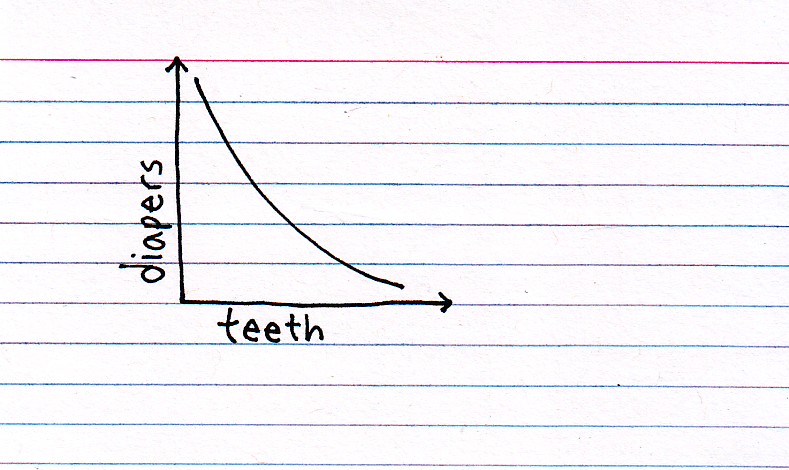
What happens when you lose your teeth? I think we need a parabola.
I thought so, too… but then I got it. ;)
As you age, you move along the x-axis until you get to the end of the curve. At that point, you begin to regress back up the curve.
As you start to lose your teeth, you’re also more likely to start needing diapers again.
What about when infants dont have teeth ?? Wouldn’t a steep bump at small x be more accurate ??
@Siddharth
Infant: No teeth, lots of diapers.
What’s not to understand?
what about during like the loss of baby teeth stage lol. How does that fit into the graph? there would have to be 2 instantaneous cases for teeth… maybe a flipping of dependent variables is in order?
This is saying as we get more teeth we use less diapers? Shouldn’t it be a little different considering we start with no teeth and use diapers, then we top out with all of our teeth and no diapers, and finish with less teeth and we go back to diapers.
That’s pretty good. Prettayyyyy prettayyyyy prettayyyyy pretty good.
No no no. You people got it all wrong. Of course, we finish with less teeth and more diapers, but this isn’t a timeline, so like what Travis said, you go back left and up the curve as time goes on.
If it was a parabola, then it would mean we never lost teeth and are in fact, growing more!
Should have been a PARABOLA :)
\_/
How many people have helped a relative out who has just suffered a stroke or alzheimer’s?
There is a reason supermarkets sell diapers for adults.
It is simple.
Baby with no teeth – Lots of diapers.
Adult with all teeth – very few diapers.
Elderly with few teeth – Lots of diapers.
If it was age to diapers it would be a parabola…
sry, i wanted to mean old age and the argument for the parabola and got it all mixed up… u are right as always.