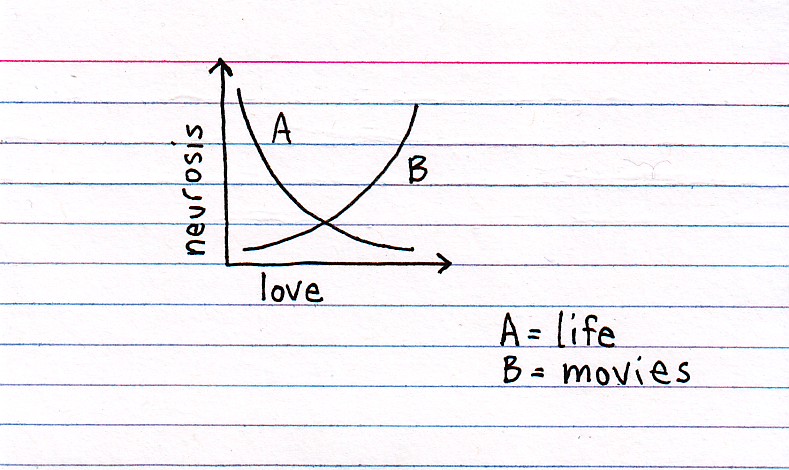
Unless you’re Woody Allen.
You can follow any responses to this entry through the RSS 2.0 feed. You can leave a response, or trackback from your own site.

This site is a little project that lets me make fun of some things and sense of others. I use it to think a little more relationally without resorting to doing actual math.

You, too can earn a living with visuals.
You can follow any responses to this entry through the RSS 2.0 feed. You can leave a response, or trackback from your own site.
March 1st, 2010 at 9:08 am
Am I being obtuse, or are the labels swapped?
I would have guessed that high neurosis is meant to be correlated with low love in real life.
March 1st, 2010 at 10:22 am
@John_T
Unless the drawing has been changed since your post, that’s what it appears to say to me.
March 1st, 2010 at 1:01 pm
That’s what it looks like to me too.
How does this work with respect to the saying ‘Life imitating art’?
Adrian
March 1st, 2010 at 10:14 pm
Both plots A and B represent high love at the right hand end of the x axis. But in B - movies - there is a correlation between increased love and increased neurosis. With plot A, as love increases neurosis decreases. you all seem to be reading the increase in the Y axis as also increase in the X axis - but the X axis is increasing from left to right, ie love is increasing, in both the plot of A and B. Plot B shows increase in both neurosis and love. low love, low neurosis. A shows low love, higher neurosis moving to high love low neurosis.
March 2nd, 2010 at 3:29 pm
Betty Blue,
Paris Texas,
Both count high in that B curve
March 4th, 2010 at 7:19 pm
[...] Go to Source [...]
March 24th, 2010 at 9:17 pm
To show Woody Allen, we’d need the z-axis.