Buy Indexed Schwag


INDEXED shirts =
adventures in turnkey capitalism.

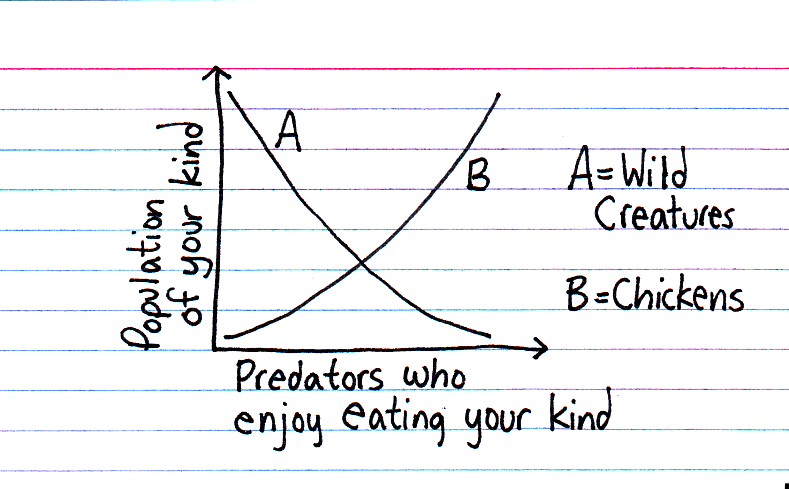
Darwin vs. KFC.


You can follow any responses to this entry through the RSS 2.0 feed. You can leave a response, or trackback from your own site.

AddThis Social Bookmark Button

11 Responses to “Darwin vs. KFC.”

  1. Very true & funny.

  2. I’ve often joked that the best way to save endangered species is to start raising them for food.

  3. Absolutely brilliant. What a way to die … to be nurtured only to be killed!!

  4. Save the earth! Eat the spotted owl!

  5. @iHunger

    The converse is true too.

    Many “weeds” are edible. As a youngster, I tried to get my parents to see the wisdom of this, figuring that if we ate the weeds from the garden, they would die off of their own accord.

    Anything to try to get out of weeding the garden.

  6. Unfortunately, as the population goes up, the quality of life goes down for those numerous chickens. Nobody looks at those factory-farm chickens and says, “Man, that’s what I call living!”

  7. Unfortunately, as the population goes up, the quality of life goes down for those numerous chickens. Nobody looks at those factory-farm chickens and says, “Man, that’s what I call living!”
    I guess you don’t live around Manhattan, then?

  8. So true!

    My parents often relate that when they were growing up a roast chicken was an infrequent delicacy, whereas nowadays they’re commodity fast food.

  9. Garrett Mclean Says:

    couldn’t be more true

    Garrett McLean at sm compufix

  10. Technically, the chicken part should be a dot, not a line. The population of the chicken species does not grow with predators, except over large periods of time. Since chickens are one species, they are a stationary dot in the upper left corner.

    I think it would maybe be funny, too.

  11. Technically, the chicken part should be a dot, not a line.
    The ideas is that as the human population grows (which is to some degree a coincidence) so does the popularity of mass produced chickens. it’s a line.

    interestingly enough, line A is in reality a kind of bell curve- a species with no predators will grow very large, but a near-extinct species will often have a singe predator (alright, alright “… and Mankind”).

Leave a Reply