
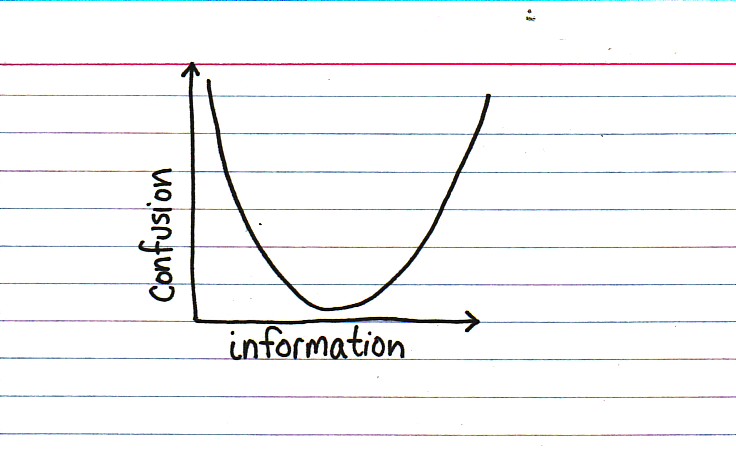
Needles and haystacks and such.
You can follow any responses to this entry through the RSS 2.0 feed. You can leave a response, or trackback from your own site.

This site is a little project that lets me make fun of some things and sense of others. I use it to think a little more relationally without resorting to doing actual math.

You, too can earn a living with visuals.
You can follow any responses to this entry through the RSS 2.0 feed. You can leave a response, or trackback from your own site.
October 9th, 2009 at 9:43 am
Hey, what the hell… the dependent and independent variables are actually on the correct axes.
October 9th, 2009 at 10:43 am
This is perfect.
October 9th, 2009 at 11:03 am
excellent…
important to remember the local minimum… not too much not too little
October 9th, 2009 at 12:21 pm
This is why I should have stopped learning things a long time ago.
October 9th, 2009 at 12:35 pm
Besides, every time I learn something new, it pushes some old stuff out of my brain. Remember when I took that home wine-making course and I forgot how to drive?
October 9th, 2009 at 1:16 pm
[...] (via) [...]
October 9th, 2009 at 1:57 pm
I would have made two lines. One for ‘data’ looking like log(x+1) and one for ‘information’ looking like 1/e^x.
With no data there is no confusion. There is nothing to be confused about. Initial date is very confusing. After a while the increase in confusion from more data becomes less significant, but still increases towards infinity.
With no information there is infinite confusion. More information always reduces confusion, asymptotically approaching an ideal state of zero confusion, but we always have more to learn.
My point is, more data may add confusion, but more information is never a bad thing.
October 9th, 2009 at 1:57 pm
er, that should be 1/(e^x - 1).
October 9th, 2009 at 3:37 pm
You need a dot labeled “the internet” at the far upper right hand corner of the paper.
October 9th, 2009 at 4:12 pm
llewelly beat me to it.
October 9th, 2009 at 4:31 pm
Hey Jessica. Loved this one, and posted a link to it.
October 10th, 2009 at 6:20 am
So beautifully put, Jessica - and so true.
@Robert de Forest: Well, not necessarily; it depends vastly on the context.
Say, you want to solve a problem. Given no information, chances are you’ll be very confused; I don’t know about you, but me - it usually scares the hell out of me. With a proper amount of info, solving the problem becomes kind of easy. Then, when given even more information, I’d tend to get confused again: my first question would be: “Why on earth do they say it to me?”. The second one would be: “My perfect solution just wasn’t that perfect; back to square N - and the confusion.”
That based on more 30 years of computer programming, but, IMHO, very valid for all kinds of practical problems as well, speaking out of bitter experience.
And - based on 6 years of teaching programing - it’s almost more than true.
But, still, yours is a good shot anyway, thought- and discussion-provoking.
October 10th, 2009 at 1:14 pm
[...] Hagy captures the information conundrum visually. Not too much. Not too little. The best speakers are able to [...]
October 10th, 2009 at 1:44 pm
e.e. cummings - all ignorance toboggans into know
all ignorance toboggans into know
and trudges up to ignorance again:
but winter’s not forever,even snow
melts;and if spring should spoil the game,what then?
all history’s a winter sport or three:
but were it five,i’d still insist that all
history is too small for even me;
for me and you,exceedingly too small.
Swoop(shrill collective myth)into thy grave
merely to toil the scale to shrillerness
per every madge and mabel dick and dave
–tomorrow is our permanent address
and there they’ll scarcely find us(if they do,
we’ll move away still further:into now
October 10th, 2009 at 11:22 pm
I think this would fit well under the “faith” label too, haha. (At least in my experience)
October 11th, 2009 at 8:50 am
Cool!
Neatly sums up my relationship with computers!
October 11th, 2009 at 9:44 am
[...] simplecomplexity.net, Cool Infographics, thisisindexed.com [...]
October 11th, 2009 at 1:14 pm
[...] de estar docerodeando puede tener sus consecuencias, como la que ilustra esta gráfica encontrada en [...]
October 12th, 2009 at 6:47 am
[...] http://thisisindexed.com/2009/10/needles-and-haystacks-and-such/ a few seconds ago from xmpp [...]
October 12th, 2009 at 9:04 pm
I would have agreed with Robert de Forest’s (Oct 9) analysis until my oldest child was > 25 yrs. After that there was *way* too much information.
October 12th, 2009 at 9:24 pm
You should get a royalty for every use of this graphic that will appear in slide decks for the next 5 years.
Very clever.
October 14th, 2009 at 5:48 am
[...] simple chart by Jessica Hagy is perfect when you think about web [...]
October 14th, 2009 at 1:32 pm
A related chart looks upside down from this one; the X axis is labeled “Degree of Certainty” and the Y, “Probability of Being Right.”
October 14th, 2009 at 3:10 pm
[...] them to start tentatively constructing their understanding of the material. You want to keep it as simple as possible, but no simpler. Your motto: Less is [...]
October 17th, 2009 at 9:41 am
“age of information an media”=∞confusion+∞information
October 19th, 2009 at 6:04 pm
[...] » Blog Archive » Needles and haystacks and such. via [...]
October 23rd, 2009 at 3:51 am
[...] gotta love Jessica Hagy. If you’ve got the skills you should be able to widen the valley in that curve [...]
October 23rd, 2009 at 6:12 am
[...] saw a link to this on Flowing Data just now. Jessica Hagy is the illustrator and author and she’s been doing [...]
October 23rd, 2009 at 2:49 pm
[...] 23, 2009 · Leave a Comment Jessica Hagy tackles the complex relationship between the amount of information we have and the level of [...]
October 23rd, 2009 at 5:16 pm
The famous ‘U’ curve, aka sophomore slump… the transition from attention to instinct.
Very nice.
October 23rd, 2009 at 6:48 pm
[...] at this graphic makes me think of NPS websites. Those that don’t have enough information are worthless to [...]
October 25th, 2009 at 5:14 pm
[...] FlowData, via Indexed Blog. This entry was posted in Other and tagged data, information. Bookmark the permalink. Post a [...]
October 26th, 2009 at 5:08 pm
[...] http://thisisindexed.com/2009/10/needles-and-haystacks-and-such/ a few seconds ago from web [...]
October 27th, 2009 at 10:27 am
[...] charts and their ability to translate concepts into simple graphical representation. This one is perfect. [...]
October 27th, 2009 at 12:09 pm
[...] from Indexed. [...]
October 27th, 2009 at 12:21 pm
[...] More You Know… By Jessica Hagy, via Andrew Sullivan. Your [...]
October 27th, 2009 at 6:53 pm
So…this is where the geeks hang out.
October 27th, 2009 at 9:39 pm
Can I get this on a shirt? A mug? A billboard? E-mail me if you add this to your store!!!!
October 28th, 2009 at 2:57 am
[...] be a proper goal but maybe a certain amount serves us well during our great pursuits. (image from here, a fun [...]
October 29th, 2009 at 6:17 am
[...] came across this nice little graph by which tries to explain the relationship between quantity of information and amo…. I think the graph is about right, although no matter what the quantity, if the quality isn’t [...]
October 30th, 2009 at 5:56 am
[...] You need a dot labeled “the internet” at the far upper right hand corner of the paper. (via thisisindexed.com) [...]
October 30th, 2009 at 11:30 am
[...] to communicate complex relationships and interactions. For example: the relationship between information and confusion. The simplicity of the approach somewhat hides the impact. We live life in flows, but we are [...]
October 30th, 2009 at 12:52 pm
[...] The Bell Curve… Via this wonderful site [...]
October 30th, 2009 at 8:16 pm
[...] I love this little chart about Needles and Haystacks. [...]
October 31st, 2009 at 1:00 am
[...] That’s it. [...]
October 31st, 2009 at 5:14 am
[...] Communicating Complexity - I have been following Indexed - a site that uses simple visuals to communicate complex relationships and interactions. For example: The relationship between information and confusion. [...]
October 31st, 2009 at 5:22 am
[...] Communicating Complexity - I have been following Indexed - a site that uses simple visuals to communicate complex relationships and interactions. For example: The relationship between information and confusion. [...]
October 31st, 2009 at 7:03 pm
[...] Communicating Complexity – I have been following Indexed – a site that uses simple visuals to communicate complex relationships and interactions. For example: The relationship between information and confusion. [...]
November 1st, 2009 at 10:38 pm
[...] A simple index card says it best (via Indexed). [...]
November 2nd, 2009 at 11:46 am
[...] example: The relationship between information and confusion. The simplicity of the approach somewhat hides the impact. We live life in flows, but we are [...]
November 13th, 2009 at 6:20 pm
[...] gotta love Jessica Hagy. If you’ve got the skills you should be able to widen the valley in that curve [...]
November 28th, 2009 at 9:27 pm
Brilliant! Where would you put Twitter on that graph?
December 5th, 2009 at 11:52 am
How can a few informations confuse you?
December 9th, 2009 at 4:08 am
Gaa! TMI! TMI!
January 15th, 2010 at 4:06 pm
[...] via: thisisindexed.com [...]
March 10th, 2010 at 7:50 am
[...] Or this particular post here: http://thisisindexed.com/2009/10/needles-and-haystacks-and-such/ [...]
March 18th, 2010 at 4:55 am
[...] Imagine preluată de pe thisisindexed.com [...]
April 6th, 2010 at 11:36 am
I’m planning to show this graph in my algebra class this week and see what the students think about it.
May 7th, 2010 at 10:55 am
Jessica,
May I have your permission to use this image in my email footer at work? I love this. Please email permission if granted.
May 10th, 2010 at 10:44 am
[...] Indexed « Darwin [...]
August 2nd, 2010 at 12:23 pm
[...] Vous pouvez retrouver ce dessin et plusieurs autres sur le blog indexed. [...]
August 4th, 2010 at 4:03 pm
[...] Jessica Hagy, visit her blog, Indexed. [...]