
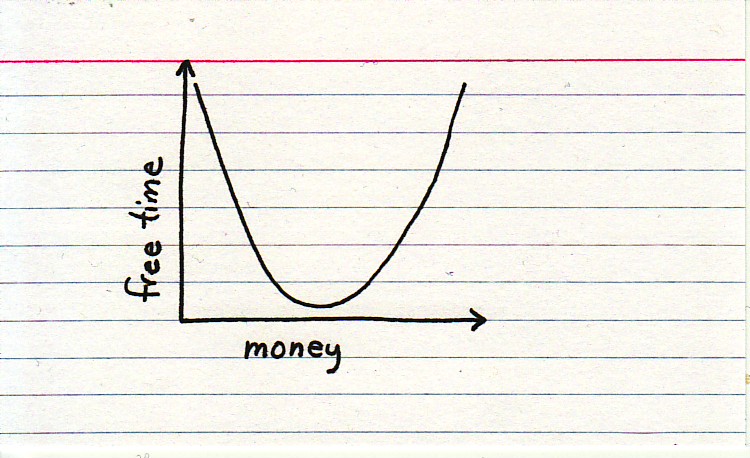
What are you doing today?

Share and Enjoy:
  • Digg
  • StumbleUpon
  • del.icio.us
  • Facebook
  • Twitter
  • Google Bookmarks
This entry was posted in consumption, expectations, finances. Bookmark the permalink.

24 Responses to What are you doing today?

  1. LZ says:

    EXACTLY! When I was a student I think I was at the far left of this… now I’m in the middle, trying to get to the right. *sigh* enough break time, back to work…

  2. JA says:

    Heh… reminds me of Office Space: “Well, you don’t need a million dollars to do nothing, man. Take a look at my cousin: he’s broke, don’t do shit. “

  3. fat girl says:

    when i grow up, i wanna be on the right side of this diagram…

    @ JA: great quote! =)

  4. CJ Guest says:

    Great representation! I wonder… if the y-axis was labeled “hard work” or “effort” would it yield an inverse curve to the one given?

  5. Jamie says:

    CJ Guest, considering how many rich people are born into money without having to work that much at all, and how many people work hard only to end up broke, I think that one might need a little more work…

  6. Megan says:

    The backward bending labor supply curve!
    Yey for microeconomics.

  7. Anonymous says:

    I disagree. (Someone is wrong on the Internet!)
    * If you are very broke, you have a lot of free time.
    * If you have only a little money, you have to work like a camel.
    * If you have some more money, you can afford a little free time.
    * If you have a lot of money, you’re working a high-responsability job and work like a camel.
    * If you are very rich, you don’t have to work at all.

    So your curve is missing a central hump; it should look more like a W.

  8. so bloody true.. .i just changed my fb status before jumping here.. lmao..

  9. davo pavo says:

    I think it’s interesting that the lowest point is where the cause and effect relationship are reversed…

    The less time you use freely (not working) the more money you have, until you hit a tipping point of being able to afford some free time.

    Very succinctly captured. (Though, that’s the point of a diagram)

  10. CJ Guest says:

    Great points Jaime and Anon.

  11. Pingback: Jessica Hagy… right on the money « Tangents and Digressions

  12. Mike says:

    True to a point. The money axis could say “perception of wealth”. ….. But then it wouldn’t be as funny.

  13. Expired Tea says:

    It would still depend on how you are going to use the time. For some people, free time still is making them money.

  14. Jemaleddin says:

    Wow – somebody has never been broke as shit working two jobs to support a family. The comments above asking for a W are along the right track, but the real answer is: hard work and effort have some relation to money and free time, but not one as direct as we like to tell ourselves.

  15. Jamie says:

    At the very least, I guess the graph is notable in that it’s gotten everybody talking about things! Kind of like Duchamp’s “Fountain” ;)

  16. TB says:

    Ah, yes. Would someone please buy our house in the midwest so we can afford to keep our apartment in NJ, where we moved for my husband’s job? *sigh*

  17. haroldo charles says:

    it is accurately what I need

  18. Pingback: Laen Aggregated » Google Shared Items - 12/29/2008

  19. Pingback: Wayne Boardman at wboardman.com » Blog Archive » This about sums it up

  20. Pingback: What are you doing today? « Breaking into the Kitchen

  21. Nilesh says:

    graph cannot reverse at tiping point.
    it needs to be flat at bottom.
    we stretch a lot-probably many years in that condiction- good earning with no free time

  22. Pingback: My Blog » Blog Archive » This about sums it up

Leave a Reply

Your email address will not be published. Required fields are marked *

*

You may use these HTML tags and attributes: <a href="" title=""> <abbr title=""> <acronym title=""> <b> <blockquote cite=""> <cite> <code> <del datetime=""> <em> <i> <q cite=""> <strike> <strong>