About
This site is a little project that lets me make fun of some things and sense of others. I use it to think a little more relationally without resorting to doing actual math.Subscribe
Archives
- May 2012
- April 2012
- March 2012
- February 2012
- January 2012
- December 2011
- November 2011
- October 2011
- September 2011
- August 2011
- July 2011
- June 2011
- May 2011
- April 2011
- March 2011
- February 2011
- January 2011
- December 2010
- November 2010
- October 2010
- September 2010
- August 2010
- July 2010
- June 2010
- May 2010
- April 2010
- March 2010
- February 2010
- January 2010
- December 2009
- November 2009
- October 2009
- September 2009
- August 2009
- July 2009
- June 2009
- May 2009
- April 2009
- March 2009
- February 2009
- January 2009
- December 2008
- November 2008
- October 2008
- September 2008
- August 2008
- July 2008
- June 2008
- May 2008
- April 2008
- March 2008
- February 2008
- January 2008
- December 2007
- November 2007
- October 2007
- September 2007
- August 2007
- July 2007
- June 2007
- May 2007
- April 2007
- March 2007
- February 2007
- January 2007
- December 2006
- November 2006
- October 2006
- September 2006
- August 2006
Categories
- 5×7
- arrogance
- booze
- brands
- communication
- consumption
- creeps
- crime
- easter bunny
- ego
- ethics
- excuses
- expectations
- experience
- faith
- family
- fashion
- finances
- friends
- gum
- halloween
- hipsters
- inequality
- kids
- language
- love
- men
- moderation
- monsters
- music
- optimism
- orthodontics
- pain
- parties
- patience
- perception
- philosophy
- politics
- pop culture
- queens
- santa
- school
- sickness
- snobs
- snuggling
- sports
- standards
- stress
- success
- technology
- television
- tooth fairy
- travel
- Uncategorized
- value
- virginity
- weight
- women
- work
- xenophobia


Where does sufficiently advanced technology fit in?
Isaac Asimov argues that X and Y are the same thing, just presented differently.
Catch; Not Isaac Asimov, but Arthur C. Clarke. His ‘Third Law’states that “any sufficiently advanced technology is indistinguishable from magic”.
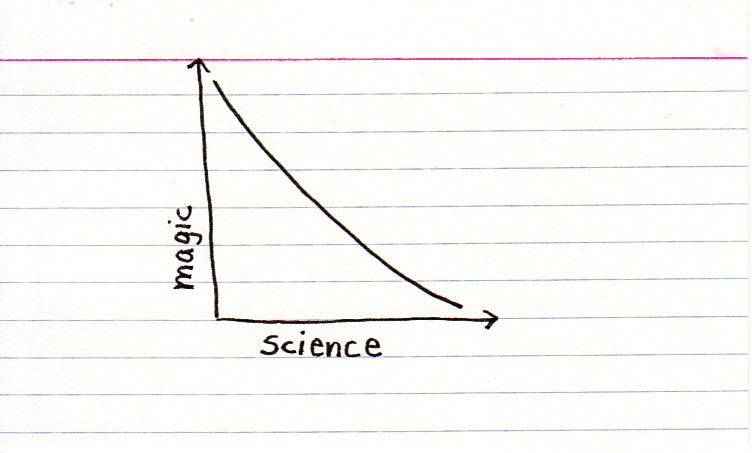
From that perspective, I think the graph would have a bell curve.
Don’t forget the corollary, “Any sufficiently advanced magic is indistinguishable from technology.”
If you don’t understand how a TV or a computer work, and someone asks you to describe how it functions, saying, “I don’t know, it’s just Magic,” and “I don’t know, it’s just technology” are effectively saying the same thing.
Am I the only one who immediately thought of Discworld on this one?
I like the Florence Ambrose take on this: “Any technology, no matter how simple, is magic to those who don’t understand it”.
That explains an awful lot about society, and depresses me when I think about it (though as an academic, I’m biased). Favourite thing I wish people had a mandatory grounding in: Statistics.
“If you don’t understand how a TV or a computer work…”
If I do know does that make me a magician?
Actually, Mike, the magician is the one who can fix it when the magic smoke escapes!
The great scholar of religion, James Frazer, said in his classic The Golden Bough that science is magic that works. One could argue from this that science is actually a subset of magic; so you might have drawn a Venn diagram showing a big circle labeled “magic” with a smaller circle inside it labeled “science”.
If, on the other hand, you’re trying to say that the world seems less “magical” as our scientific understanding reduces our willingness to believe in the supernatural, then I think the issue is not science as such but rather the common but incorrect belief that science tells us what is real (and, even worse, that if science can’t explain something, then that thing isn’t real). My favorite quote on this subject comes from the great physicist Stephen Hawking, who once explained his acceptance of quantum mechanics in spite of logical absurdities like a cat that is dead and alive at the same time by saying, “I don’t know anything about reality. All I care is that a theory should be able to predict the outcome of experiments.” This is a profound statement about the nature of science that most people, especially at the popular-science level, do not really understand.
I usually enjoy Indexed (and I did buy the book), but this entry falls flat for me.
In my head I inmediately replaced “magic” by “religion”. Works fine too.
The world may no longer be flat, but there’s still magic available.
http://www.boxoftextures.com/images/clarke.jpg
I was an engineering student in college. I gotta say some of those texts looked like black magic to me.
I would almost disagree. It would seem to be that the more science we discover, the more magic there is. Or possibly it remains constant. There’s always that bit of science that we just don’t know how to explain. =)
Anyways, love your blog, keep it up.
I think it varies on your outlook. Studying science can leave you thinking, “I understand it now!” It can also leave you thinking, “Well, now I don’t understand anything at all!”
If this graph were completely true, it would truly be a sad world.
This one I’d buy on a t-shirt
Shouldn’t they be inversely proportional? To me it seems lie there will always be some (magic|unknowns) left.
Jonathan, that depends on whether or not you treasure the wonders of reality. If something has to seem magic or supernatural to be of wonder to you, that’s what’s sad. Try embracing the wonder of reality and what science has to teach us about it. You might be blown away.
The more I learn, the more wonderful the world is.
There’s another diagram @indexed almost related to the last sentence of Isherwood’s post.
Something like “the more you know, the more you know you don’t know”.
This teacher of mine liked to represent knowledge as concentric circles. As you learn stuff, the area in it becomes bigger, but so does its boundary, which represents the points where you realize there is something else beyond your knowledge.
Regards, nice blog!
Why the line isn’t simply a zero flat value? Magic doesn’t exist, whatever the scientific insight!
Actually, thinking about quantum mechanics, I actually would have drawn an Heaviside step function…
Any sufficiently advanced technology is indistinguishable from garbage
@Peter Bradford: Asimov used it in the Foundation series, although after Clarke.
I made myself a T-shirt like that over four decades ago, except it was U-shaped and the right-hand end was labelled “quantum-mechanics” ;-)
magic to me is wonderment. magic and science are therefore either unrelated, or, science produces more wonderment. like how the hell this screen can possibly work – it’s amazing and wonderful, and magical.
> Don’t forget the corollary,
> “Any sufficiently advanced magic
> is indistinguishable from technology.”
In the television series “Babylon 5,” the technomages were a group of people who used technology to create the appearance of magic.
http://en.wikipedia.org/wiki/Technomage
Gregory Benford’s corollary is that any technology which IS distinguishable from magic is insufficiently advanced.
Neat.
Bravo!
“Perceived Magic” as a function of “Misguided belief that you know everything about science” also works.
so true!
perhaps there will me more versions of this, judging by the above comments (technology, religion, etc)?
>any sufficiently advanced technology is indistinguishable from magic>Don’t forget the corollary, “Any sufficiently advanced magic is indistinguishable from technology.”<<
Or the reversal: Any technology distinguishable from magic is not sufficiently advanced.
Instantly reminded me of this:
http://www.dimaggio.org/images/Heroes/miracle.jpg
And also this:
http://fy.chalmers.se/~f3amj/Pics/magic.gif
The problem with our discussion here is that “magic” is undefined. What do you mean by the word? The truth of this comic depends on whether you’re using the words in the same way Jessica is.
Jessica, you are always so insightful, but in this case I have to flatly disagree. Read a little about dark matter, dark energy, quantum entanglement, the black hole at the center of the Milky Way, siRNA, cell signalling, and it appears that science is revealing the universe to be magical in a way that transcends our ability to imagine. Science makes room for more magic, such that the old fairy tales hardly seem magical at all by comparison.
Thanks, PG.
They are both heroes of mine. One I met a few times; the other I wish I had :-(
There is no magic. Magic is simply a label given to technology that is not understood. Even if the Harry Potter movies were documentaries, it wouldn’t change anything. I dislike the word magic because it not only uses a fairly useless label in place of a valuable description, it is a tacit approval of ignorance.
“It’s magic.” is either a declaration by the speaker that understanding is beyond his reach, or an accusation that understanding is beyond the reach of the listener. Both are a disservice to science.
“Any sufficiently analyzed Magic is Indistinguishable from Science” — Agatha Heterodyne from Girl Genius
as we all know from monty python and the holy grail, the world is banana shaped. this new science astounds me.
I’d like to see where ‘belief’ fits into this whole spectrum…
“Am I the only one who immediately thought of Discworld on this one?”- BigScott
I did too!
This should be a parabola.
I think it’s funny when people think science and spirituality are at odds with each other. They’re actually very complementary. Kind of like how many Japanese hold to both Shinto and Buddhist traditions, even though in some ways they contradict. It’s a dynamic you have to allow yourself to experience in order to truly grasp.
@Ditocoaf:
Exactly. Come on, obviously smart folks! Stop messing about with what you personally think “magic” means, and understand the graph in the sense that Jessica clearly intended it: “magic” not as wonder, coolness, spirituality, mojo, or the inexplicable, but rather as an explanation itself, at odds with the more scientific (and invariably more useful, and therefore invariably more accurate) explanation of how anything works.
In short: the more we can explain with well-defined science, the less we need explain with some vaguely defined “magic” (whether your magic is crystals, homeopathy, psychics, gods, or pretty much anything else that has long ago ceased to be a viable explanation). Which is a good thing, as demonstrated by the utter confusion here over the definition of magic itself!
Well in order to produce magic, whether it be the magic of the IPhone, or the magic of an actual magic show, or the magic of a movie, it involves a concerted effort to harness technology, science, a ton of editing, refining, tweaking, rehearsal to produce that magical experience. I like this “production” connotation of magic. Magic has an interface, it’s a well-produced show. And yes nature has got the sunset show down pretty pat by now.
I think the people who are disagreeing with the diagram mistake ‘magical’ (as in inspiring a sense of awe), with ‘magic’ (as in a lazy explanation for what you don’t understand). I love science because it actually increases the perceived beauty of my world, while things the currently have no explanation just make me think “what will the explanation for that be, and will we find it in my life time”.
Also, don’t confuse ‘actual’ magic with stage magic (that latter is just more science)
‘“Am I the only one who immediately thought of Discworld on this one?”- BigScott
I did too!’- Lauren
Three Terry Pratchett fans make a very odd crowd. I wonder how the Turtle feels about heliocentricity.
Eunoia: Very odd shape for a T-shirt :-D
Who is Stephen Hawking??Am I the only one singing white and nerdy..??