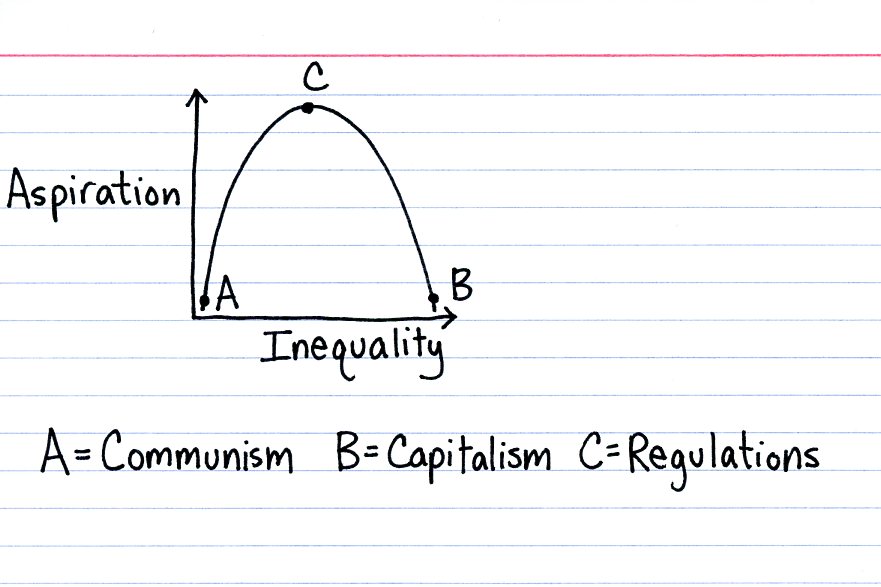
Extremism gets ugly fast.

Share and Enjoy:
  • Digg
  • StumbleUpon
  • del.icio.us
  • Facebook
  • Twitter
  • Google Bookmarks
This entry was posted in moderation, value. Bookmark the permalink.

8 Responses to Extremism gets ugly fast.

  1. Dean says:

    To be correct: Capitalism for purposes of this chart and all modern discussion means what in antiquity was referred to as Mercantilism, or a guild-restricted market space, where politically-connected industry associations secure profits through barriers to market entry or cash bailouts/bailout projects (both of which lower aspiration and increase inequality). Not depicted on the graph is the Free Market, which is what created the large and rapidly growing economy of the U.S. up until the early 20th century at which point the discussion moved in the direction so smartly illustrated here. The regulated economy is the same as the Capitalist/Mercantilist economy as the regulations are written by the Mercantilists to appease the Communists, while maintaining their advantage. If the “Aspirations” were plotted and the Free Market was on the X-axis, you would have a golf-club-shaped graph.

  2. John says:

    To quote Victor Hugo:

    First problem: Produce wealth. Second problem: To distribute it…

    England solves the first of these two problems. She creates wealth admirably; she distributes it badly…

    Communism and Agrarian law think they have solved the second problem. They are mistaken. Their distribution kills production. Equal partition abolishes emulation. And consequently labor. It is a distribution made by the butcher, who kills what he divides…

    The two problems must be solved together to be well solved. (Victor Hugo, Les Miserables, pp. 840-841)

  3. Adam says:

    I’m having a hard time understanding why Capitalism would be associated with similar levels of aspiration to communism. I grant that there are more inequalities present in capitalistic societies, but doesn’t the inherent inequality in compensation drive some people to aspire to enter certain professions?

  4. Pete says:

    The only way that chart makes sense is if you are looking at it from the viewpoint of the people running a centrally planned government. At which point, yes, Communism is absolutely fair (to them) because all the wealth generated by the people is concentrated with those in charge. Reference Cuba, China, North Korea, etc. Where-as, under a capitalist society, the wealth earners keep their money away from the government because they didn’t (the government) expend the effort in earning it.

    …but from the perspective of a work-a-day joe like me… yeah, you got Points A & B backwards.

  5. Alejandro says:

    As a Cuban, I must say that the only thing well distributed in communism is poverty, while aspiration is really high, which leads to increasing frustration, anger and desperation and a really poor quality of life.

    Perhaps too many variables… :)

  6. Cal says:

    Reads right to me. Under Dean’s Free Market, the logical endpoint of competition is oligarchy (oligarchs hate and will resist monopoly), where the number of actual capitalists is minimal. Aspirations are low for many, seeing little means of breaking into the oligarchy. That this does not fully describe American capitalism is due to both regulation and invention, which latter doesn’t overturn the oligarchs as much as bypasses them in inventing new markets altogether (viz. automobiles vs. rail, etc. )

  7. Fasteddie says:

    This is a great graph. Unregulated capitalism leads to capital just flowing into the hands of the capitalists, resulting in high inequality and thus low aspirations. If you need money to make money, and you don’t have any money, you’re pretty much stuck. Regulations are how we try to make it work. Our big problems have come when the Capitalists are able to co-opt the regulators.

  8. Spero says:

    Reading all these comments really tells me nothing, aside from how loaded the words ‘communism’ and ‘capitalism’ are. It seems as if 80% of the people who use these terms have no idea what the meaning of them are, especially not some self-styled economists…

    Though I must admit to some confusion, to the chart that is, in how the term aspiration is being used. Is it meant to mean the hope of rising upwards or ?

Leave a Reply

Your email address will not be published. Required fields are marked *

You may use these HTML tags and attributes: <a href="" title=""> <abbr title=""> <acronym title=""> <b> <blockquote cite=""> <cite> <code> <del datetime=""> <em> <i> <q cite=""> <strike> <strong>