About
This site is a little project that lets me make fun of some things and sense of others. I use it to think a little more relationally without resorting to doing actual math.Subscribe
Archives
- May 2012
- April 2012
- March 2012
- February 2012
- January 2012
- December 2011
- November 2011
- October 2011
- September 2011
- August 2011
- July 2011
- June 2011
- May 2011
- April 2011
- March 2011
- February 2011
- January 2011
- December 2010
- November 2010
- October 2010
- September 2010
- August 2010
- July 2010
- June 2010
- May 2010
- April 2010
- March 2010
- February 2010
- January 2010
- December 2009
- November 2009
- October 2009
- September 2009
- August 2009
- July 2009
- June 2009
- May 2009
- April 2009
- March 2009
- February 2009
- January 2009
- December 2008
- November 2008
- October 2008
- September 2008
- August 2008
- July 2008
- June 2008
- May 2008
- April 2008
- March 2008
- February 2008
- January 2008
- December 2007
- November 2007
- October 2007
- September 2007
- August 2007
- July 2007
- June 2007
- May 2007
- April 2007
- March 2007
- February 2007
- January 2007
- December 2006
- November 2006
- October 2006
- September 2006
- August 2006
Categories
- 5×7
- arrogance
- booze
- brands
- communication
- consumption
- creeps
- crime
- easter bunny
- ego
- ethics
- excuses
- expectations
- experience
- faith
- family
- fashion
- finances
- friends
- gum
- halloween
- hipsters
- inequality
- kids
- language
- love
- men
- moderation
- monsters
- music
- optimism
- orthodontics
- pain
- parties
- patience
- perception
- philosophy
- politics
- pop culture
- queens
- santa
- school
- sickness
- snobs
- snuggling
- sports
- standards
- stress
- success
- technology
- television
- tooth fairy
- travel
- Uncategorized
- value
- virginity
- weight
- women
- work
- xenophobia


Hooray for our granpas and grammas :)
I ask the same question… Or is it just for contrariness? I really do believe we hold on to wisdom.
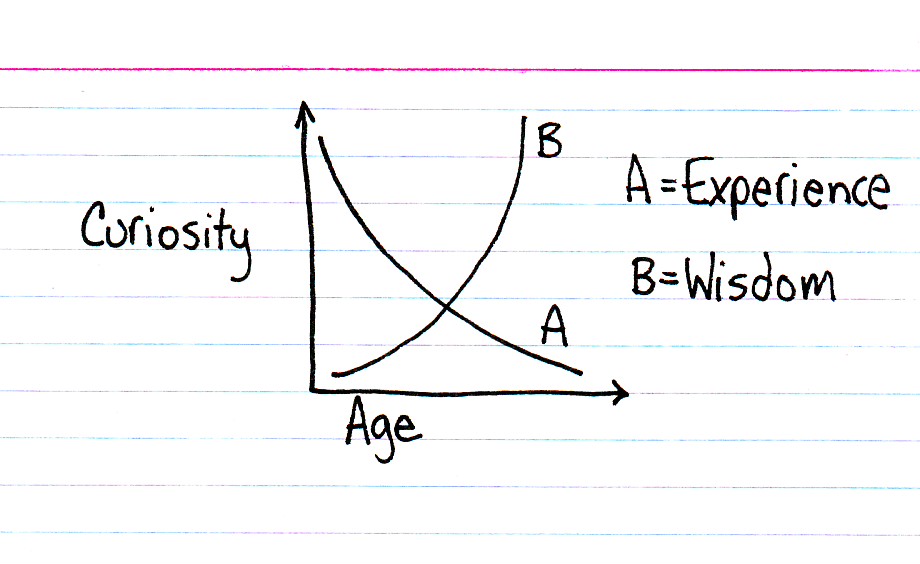
shouldn’t the B line start high and remain high?
I don’t believe children are usually considered wise, but are certainly curious. Wisdom comes with age.
But one could say that holding onto a child-like level of curiosity is a marker of wisdom. (Remember that the function is titled “wisdom”, but what’s being charted is curiosity, so placing B as a horizontal line at the top of the chart wouldn’t indicate that children are wise.)
That said, children can say some incredibly wise things. I think we lose wisdom as we age, and then regain it. ;)
I don’t think the B line reflects wisdom on an axis, so much as it claims that the increase of curiosity through time is indicative of wisdom. Thus the above comment requires that, as a prerequisite for wisdom curiosity is always at an elevated level, in addition to increasing through time.
I ask the same question…Shouldn’t the B line start high and stay high? Or is it just for contrariness? I really do believe we hold on to wisdom.
How dumb am I for not getting this graph?
Wisdom raises as we grow older but experience decreases?
no, experience can dampen your curiosity (the actual y-axis label), but with wisdom your curiosity only increases with time.
Is there any significance to the point where the two curves intersect?
“not yet a nosy old coot” or “not yet ready to believe old wives tales without checking wikipedia and snopes.com”
> “Is there any significance to the point where the two curves intersect?”
Yes. That’s the point where you suddenly realize you are getting ols. [sigh]
s/ols/old/
Hms, don’t quite agree with this one…
Age gains experience true, but only if you stay curious, so you obtain experience.
Doing the same thing over and over will give you a flat line, at one point you’ll find everything there’s to know about that one little facet, whiles trying other things will broathern your range of things you’re experienced in.
Greetings,
Toot-
I interpret line A as the “been there, done that” kind of experience – losing your curiosity because you think you’ve already seen everything. True Wisdom means staying curious and always open to new things even in later years.
Or as the German author Erich Kästner once said: “Becoming an adult and yet staying a child – that’s truly human.”
Well, that’s depressing…
o was just wondering why my daughter thinks she is smarter than me, i mean, she is…but why would she think that? And why doesn’t she know about all the stuff that I know about?
How to read this graph? Are these equipotential surfaces? i.e. for a given quantity of wisdom, this shows the various possible combination of age and curiosity. Then that would mean that a child with low curiosity has same wisdom as an elder with more curiosity? Something is missing.
I guess wisdom, to a large extent, is realising that there is so much out there that is exciting and that we don’t know about, and that increases curiosity. That’s why the path to wisdom is where the curiosity keeps increasing…
Whereas if we begin to feel that we know it all/have experienced it all, we carry on having the experiences, but gain less from them, and hence we lose our curiosity…